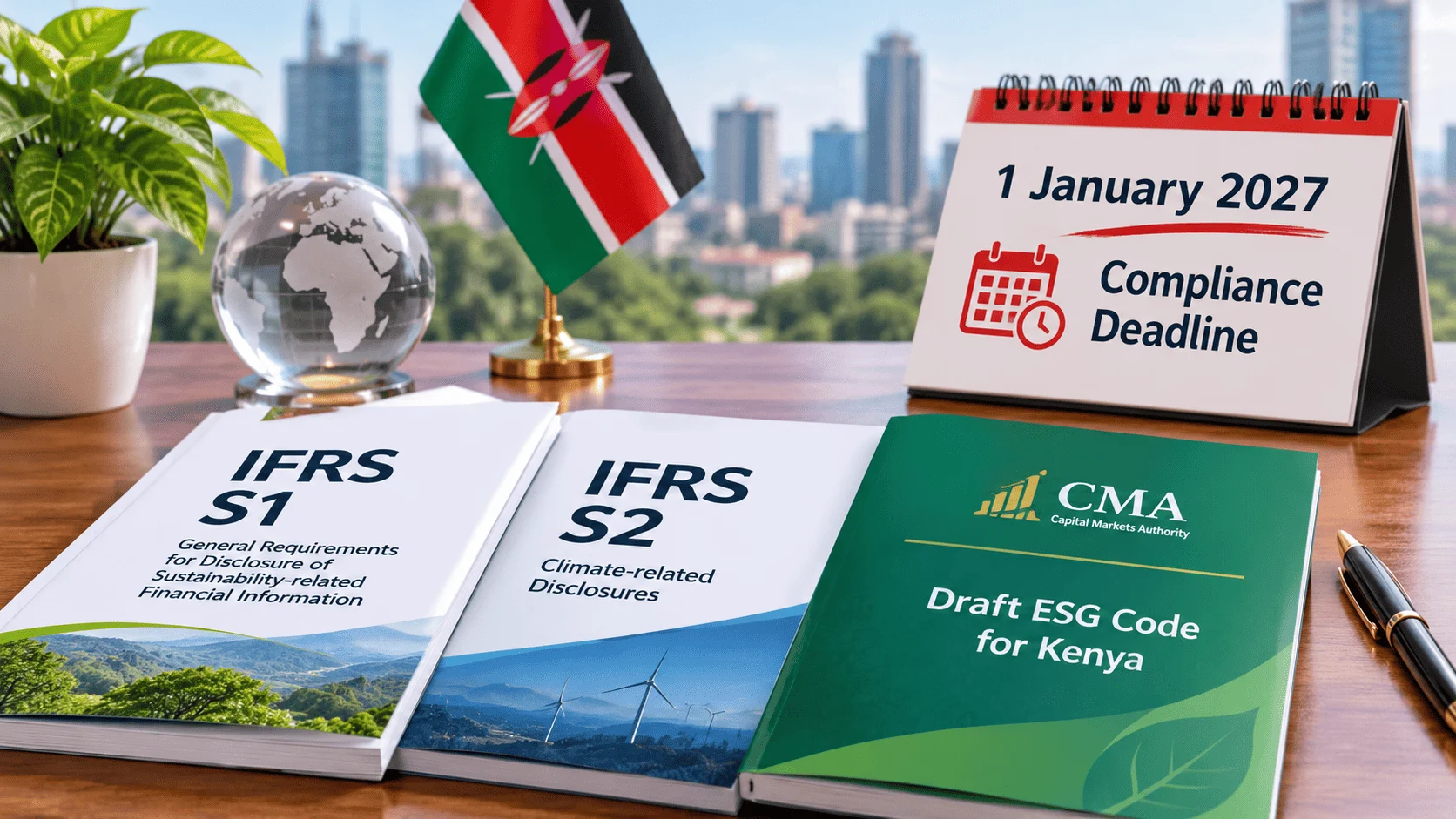
In short, from the financial year beginning 1 January 2027 every listed company, bank, insurer, pension scheme, licensed fund manager, deposit-taking SACCO and large state corporation in Kenya must report its sustainability and climate-related risks under IFRS S1 and S2, alongside and to the same standard as its financial statements. The readiness assessment the Institute of Certified Public Accountants asked for was due on 30 June 2026. The Capital Markets Authority’s Draft ESG Code, published on 13 July 2026, adds board-level duties for issuers with mandatory provisions expected within a year. As at the middle of 2026 only one listed group had published a report the standards would recognise. This article says who is caught and when, what the standards and the Code require of the board itself, the reliefs available in the first year, and the eleven things a board does between now and the deadline.
The date in the title
Boards in Nairobi have heard the letters IFRS S1 and S2 for two years, usually from the auditors and usually as something the finance team would handle. The date has now arrived at which it stops being a finance matter. Under the adoption roadmap issued by the Institute of Certified Public Accountants of Kenya with the Nairobi Securities Exchange and the regulators, the standards become mandatory for public interest entities for reporting periods beginning on or after 1 January 2027, which means the report for the year to 31 December 2027, published in early 2028, must comply, and the systems which produce it must be running from the first day of 2027. The Institute asked every entity in the first phase to complete a readiness assessment by 30 June 2026, a gap analysis of data availability and internal controls across the four pillars of the standards. Many boards have not seen theirs.
Who is caught, and when
| From | Entities | First compliant report |
| 1 January 2027 | Public interest entities. Companies listed on the Nairobi Securities Exchange, banks licensed by the Central Bank, insurers licensed by the Insurance Regulatory Authority, pension schemes under the Retirement Benefits Authority, fund managers licensed by the Capital Markets Authority, deposit-taking SACCOs under SASRA, and large state corporations | Year ending 31 December 2027, published in 2028 |
| 1 January 2028 | Large private entities exceeding two of three thresholds, turnover above KES 100,000,000, assets above KES 250,000,000, or more than 250 employees | Year ending 31 December 2028 |
| 1 January 2029 | Small and medium enterprises | Year ending 31 December 2029 |
Two things in the table are missed. The first phase is not confined to listed companies. A privately owned bank, an insurer, a SACCO and a fund manager are in it, and most of them have no sustainability function at all. And the second phase reaches almost every substantial private company in the country, since a turnover of KES 100,000,000 and 250 employees describes a mid-sized manufacturer, a school, a hospital or a logistics business, so a board which believes this concerns the Nairobi Securities Exchange alone has one more year than it thinks and no more.
What the standards ask of the board, not the finance team
IFRS S1 sets the general requirements for disclosing sustainability-related risks and opportunities reasonably expected to affect the entity’s cash flows, access to finance or cost of capital over the short, medium and long term. IFRS S2 applies the same structure to climate. Both are built on four pillars, governance, strategy, risk management, and metrics and targets, and the first pillar is written about the board.
Under governance the entity must disclose the body responsible for oversight of sustainability-related risks and opportunities, how its responsibilities are reflected in its terms of reference and policies, how it determines whether appropriate skills and competencies are available to it, how and how often it is informed, how it takes those risks into account when overseeing strategy, major transactions and risk management, and how it oversees targets and whether performance against them affects remuneration. Every one of those sentences requires a board decision before it is capable of being disclosed truthfully. A board which has not assigned the oversight, amended the charter, assessed its own skills or decided the remuneration question has nothing to report under the first pillar except the fact it has done none of them.
Under strategy the entity discloses the sustainability and climate risks it faces, their current and anticipated effects on its business model, strategy and financial position, its transition plan, and its resilience under climate scenarios. Under risk management it discloses how those risks are identified, assessed, prioritised and monitored and how the process is integrated into enterprise risk management. Under metrics and targets it discloses its greenhouse gas emissions in Scope 1, Scope 2 and Scope 3, its climate-related targets and its progress against them. The disclosures are made at the same time as the financial statements, for the same reporting entity, connected to the numbers in the accounts, and they carry the same expectation of internal control and, on a phased basis under the international assurance standard, the same external assurance.
What the CMA’s Draft ESG Code adds for issuers
On 13 July 2026 the Capital Markets Authority published its Draft ESG Code for Issuers of Securities to the Public, developed with the International Finance Corporation and the Nairobi Securities Exchange. It sits on top of the 2015 Code of Corporate Governance Practices and, for the first time, moves the regime from apply or explain to apply and explain. An issuer will be required to explain how it applies each principle, to justify any departure and to disclose a timetable for closing the gap, which is a different exercise from writing a paragraph about why the principle does not suit the company.
The draft’s mandatory provisions require the board to adopt a documented ESG framework and to oversee sustainability-related risks, to report on sustainability annually, to set measurable board diversity objectives, to link variable executive pay to sustainability objectives through ESG metrics as well as to financial performance, and to treat an independent director as no longer independent after six years of service, a cap below the nine years in the 2015 Code. The Authority has said the mandatory provisions will be expected to be implemented within one year of the Code’s publication, which places the deadline in the middle of 2027, in the same year as the first IFRS S1 and S2 reporting period. A board of a listed company therefore faces two instruments arriving together, one governing what it discloses and one governing how it is constituted, paid and run.
The reliefs in the first year
The standards themselves contain transitional reliefs for an entity’s first annual reporting period, and the Kenyan roadmap as published has not removed them. In the first year an entity may report on climate-related risks alone under IFRS S2 and defer the wider sustainability disclosures under S1, may omit comparative information, may omit Scope 3 emissions, and may publish its sustainability disclosures after its financial statements rather than with them. Each relief is worth taking, and each is worth understanding for what it is. Climate first is not climate only for long. No comparatives in year one means year two must show two years, so the data for 2027 must be captured to a standard which survives comparison. The Scope 3 relief postpones the hardest measurement by twelve months. And the timing relief is a relief on publication, not on preparation. A board should confirm which reliefs it is relying on and minute the decision, because the disclosure must say so.
Why this is a legal question and not only an accounting one
Three reasons. Section 143 of the Companies Act, 2015 requires a director, in promoting the success of the company, to have regard among other things to the impact of the company’s operations on the community and the environment, and a board which has never assessed those impacts is in a weak position to say it had regard to them. Sustainability disclosures made in an annual report are statements to the market, and a false or misleading statement in an issuer’s report carries liability under the Capital Markets Act and, where investors rely on it, in the ordinary law, so a target announced to satisfy a template and quietly abandoned is a liability rather than an aspiration. And the Draft ESG Code’s provisions on pay, tenure and diversity are governance rules which, once mandatory, are enforced by the Authority in the same way as the 2015 Code, through the annual scorecard and, where explanations fail, through enforcement proceedings.
What the board does between now and 1 January 2027
- Confirm the phase. Establish which phase the company falls in, and for a group, which subsidiaries fall in which phase, since a listed parent with a bank, an insurer and a SACCO in the group has several first-phase entities, each reporting.
- Assign the oversight. Decide whether the board itself, the audit and risk committee or a new sustainability committee holds oversight, amend the board charter and the committee’s terms of reference to say so, and minute the decision. This is the first disclosure under the governance pillar and it is unable to be written until the decision exists.
- Assess the board’s skills. The standards require disclosure of how the board determines it has the competencies to oversee these risks. Run the assessment, record it in the annual board evaluation, and arrange the training the gap shows, counting it towards the twelve hours the 2015 Code requires of each director.
- Find or commission the readiness assessment. If the gap analysis due on 30 June 2026 was done, the board reads it. If it was not, it is commissioned now, across the four pillars, with a dated remediation plan the board adopts.
- Decide what is material. The standards disclose what is reasonably expected to affect enterprise value, not everything the company does for the community. A materiality assessment, approved by the board, decides which risks and opportunities are in the report and is itself disclosed.
- Build the data and the controls. Scope 1 and Scope 2 emissions from 1 January 2027 at the latest, with a plan for Scope 3 in year two, captured under internal controls the auditors will test. Where local emission factors do not exist the international sources the Institute has named are permitted, and the choice is documented.
- Run the scenario analysis and adopt a transition plan. IFRS S2 requires climate resilience to be assessed against scenarios and a transition plan to be disclosed if the entity has one. A board without one discloses the absence, which is a disclosure the market reads.
- Adopt the ESG framework the Draft Code requires. A documented framework, approved by the board, setting the policies, the responsibilities and the reporting lines, drafted so it satisfies the Code when it becomes mandatory and the standards’ governance pillar at the same time.
- Decide the pay question. Whether and how variable executive pay is linked to sustainability metrics, which the Draft Code will require of issuers and which the standards require to be disclosed by everyone. The remuneration committee decides, the board approves, the shareholders are told.
- Prepare for assurance. Assurance is phased from limited to reasonable under the international standard, and the auditors will want the same evidence trail they want for the accounts. The board agrees the assurance scope and timetable with the auditors now rather than in January 2028.
- Fix the reporting calendar. Sustainability disclosures are published with the financial statements, subject to the first-year relief, and the annual report, the integrated report, the sustainability report and the CMA governance disclosures are one connected exercise on one timetable, owned by one committee, and cross-referenced in a content index.
Boards outside the first phase
A large private company in the second phase has a year longer and the same list. A foreign subsidiary whose parent already reports under the standards, or under the European directive which mirrors them, inherits the group’s framework and needs a Kenyan reporting entity, a Kenyan materiality assessment and a Kenyan board minute. A company below every threshold is under no obligation, and will be asked for the disclosures anyway by the bank which lends to it and the listed customer which buys from it, because Scope 3 is the supply chain, and the supply chain is where the second and third phases meet the first.
What we do
We advise boards on the governance side of the transition. We confirm the phase and the entities in scope, draft the charter and committee amendments, the ESG framework and the remuneration provisions, run the board’s skills assessment alongside its annual evaluation, review the readiness assessment and the disclosure drafts for the statements the board is able to stand behind, and prepare the board’s response to the Authority’s consultation on the Draft Code. The accountants build the data. We make sure the board has decided what the data is for. The engagement is quoted as a fixed fee for the board readiness review, with the drafting quoted separately.
Questions we are asked every week
Does IFRS S1 and S2 apply to my company?
From 1 January 2027 if you are listed, a bank, an insurer, a pension scheme, a licensed fund manager, a deposit-taking SACCO or a large state corporation. From 1 January 2028 if you exceed two of three thresholds, KES 100,000,000 turnover, KES 250,000,000 assets or 250 employees. From 2029 for everyone else.
We missed the 30 June 2026 readiness assessment. What now?
Commission it now, across governance, strategy, risk management and metrics, and adopt a dated remediation plan at board level. The assessment was the Institute’s advisory, and the standards’ effective date is the deadline which matters.
Is it possible to report only on climate in the first year?
Yes. The standards allow an entity to report under IFRS S2 alone in its first year, to omit comparatives and Scope 3, and to publish after the financial statements. The board should decide which reliefs it is using and say so in the report.
What does the CMA Draft ESG Code change for a listed board?
Apply and explain replaces apply or explain, a documented ESG framework becomes mandatory, board diversity needs measurable objectives, variable executive pay must link to ESG metrics, and an independent director loses independence after six years. Mandatory provisions are expected within a year of the July 2026 publication.
Who signs off the sustainability report?
The board, in the same way it approves the financial statements, and under the governance pillar it discloses how it did so. Directors carry the same responsibility for these statements as for the accounts.
Is external assurance required?
On a phased basis, moving from limited to reasonable assurance under the international sustainability assurance standard. Agree the scope with the auditors this year.
We are a foreign subsidiary and the parent already reports. Are we done?
Not quite. The Kenyan entity reports for itself, with its own materiality assessment, its own board oversight and its own minute, using the group’s framework and data where they fit.
Next step
If your board has not yet decided who holds oversight, or has not seen its readiness assessment, send us the board charter, the last annual report and the group structure by e-mail to peter@pmlaw.co.ke or WhatsApp through +254 714 644 080. We reply within one working day with the phase you are in, the decisions the board owes before 1 January 2027 and a fixed fee for the readiness review. Nothing is charged until you instruct us.
Peter Maina is a Partner of Peter Maina & Company Advocates, Hazina Towers, Nairobi. He is an Advocate of the High Court of Kenya practising in corporate governance, capital markets, corporate and commercial, and real estate law, and advises boards of listed companies, regulated institutions and private groups on governance and disclosure.
Leave a Reply