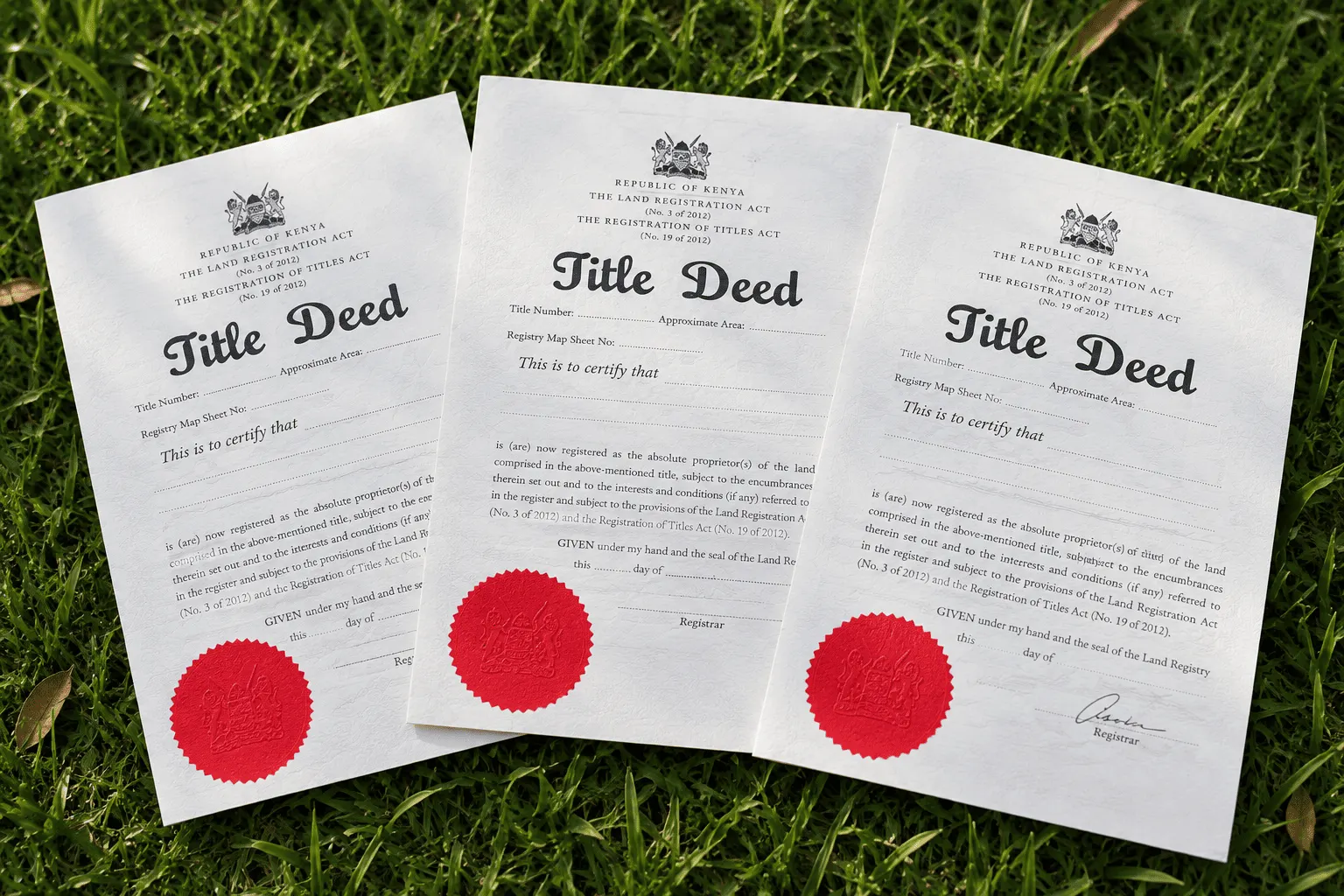
In short, a title deed in a seller’s hand proves almost nothing on its own. What proves ownership is the register at the land registry, the parcel file behind it, the map, the ground and the person, checked in this order and before any money changes hands. This article sets out the seven checks we run on every purchase, what each one costs, how long it takes, and what to do the moment one of them fails.
The moment you are in
You have found the land. The seller has shown you a title deed, perhaps a photograph of one on WhatsApp, perhaps the original across a table, and has asked for a deposit to hold the parcel because another buyer is interested. You want to know whether the person in front of you owns what he is selling, and you want to know before Friday.
Start from one fact. Under section 26 of the Land Registration Act, 2012 a certificate of title is conclusive evidence of ownership, and a court will not go behind it, except where the title was obtained by fraud or misrepresentation to which the holder is a party, or was acquired illegally, unprocedurally or through a corrupt scheme. Both exceptions are pleaded in the Environment and Land Court every week. So the question is never whether the seller has a title deed. It is whether the register agrees with the deed, whether the register itself deserves to be trusted, and whether the land on the register is the land you have been shown.
The National Crime Research Centre’s survey of land crime found fraud named as the most prevalent land crime by 30.7 percent of Kenyan households, with brokers and cartels behind 41.4 percent of cases and family members behind 39.7 percent. Almost every one of those cases began with a buyer who trusted a document instead of checking a register.
The seven checks
- The document itself. Ask for the original, not a copy, and look at it properly before anything else. Note the title number, the registry which issued it, the registered proprietor’s full name and identity number, the size of the parcel, whether it is freehold or a lease and, if a lease, the term and the date it began. A title issued under the Land Registration Act will read as a certificate of title or a certificate of lease. Older titles issued under the repealed Registered Land Act, Registration of Titles Act or Government Lands Act are still valid, but many have been replaced with new parcel numbers under the Ministry’s conversion programme, so a seller holding an old title may need to show you the gazette notice which converted it and the new number. An allotment letter is not a title. A share certificate in a land-buying company is not a title. A sale agreement between the seller and the person he bought from is not a title. Only a certificate of title or lease, matched to the register, is.
- The official search. This is the check everything else hangs on. An official search is a certified extract of the register showing who the proprietor is today, the size and tenure of the parcel, and every charge, caveat, caution, restriction and court order registered against it. For Nairobi and the counties which have moved onto Ardhisasa the search is applied for through the platform, costs a few hundred shillings in registry fees and comes back within a day, though a search on land you do not own requires the registered owner’s consent through the system, which is itself a small test of the seller’s good faith. For counties still on the manual registers the search is lodged at the local land registry and takes a few days. Do not accept a search the seller hands you. Obtain your own, through your advocate, dated within the last few days. A search older than a week tells you what was true then, not now.
- The root of title. A search tells you the present state of the register. It does not tell you whether the register should have reached its present state. Where a title is young, where the parcel was subdivided recently, where the land passed through an estate, a company, an auction or a land-buying scheme, or where the search shows a chain of transfers in quick succession, we go behind the certificate to the parcel file at the registry, to the green card on the older registers, and to the mother title from which the parcel was carved. We are looking at how each owner came to be registered, whether the consents and signatures are there, and whether the subdivision was approved and surveyed. Most forged and fraudulently obtained titles fail here, because the forger produces a clean certificate and a clean search but never manages to produce a coherent file behind them.
- The map and the ground. A title describes a parcel by number. The number lives on a map, either a deed plan for the older LR titles or the registry index map for the newer parcel numbers. A licensed surveyor obtains the map from Survey of Kenya, walks the parcel with it, finds the beacons and confirms the land you have been shown is the land on the map. This costs a few tens of thousands of shillings and it is never skipped, because the oldest trick in the trade is to show you a good plot and sell you a title to a different one, sometimes in a different county. The same visit tells you whether the parcel sits on a road reserve, a riparian strip, a power line wayleave or public land, any of which makes the title revocable, and whether someone is living on it, which raises questions of adverse possession and of who is in control.
- The seller. Match the seller to the register, not the register to the seller. We take the original national identity card or passport and the KRA PIN certificate and compare every detail with the proprietor named on the search. We confirm the seller is alive, which sounds absurd until you learn how many parcels are sold by people who died years earlier. Where the proprietor is dead, the person selling must hold a confirmed grant of representation and the land must first be transmitted into the administrator’s name, because under the Law of Succession Act an administrator has no power to sell before confirmation. Where the seller is married, we ask about spousal consent, since the Matrimonial Property Act, 2013 and the Land Registration Act both protect the home. Where the seller is a company we check its beneficial owners, its directors and the resolution authorising the sale. And where the seller is an agent or a relative acting for the owner, we ask for the power of attorney and check it is registered, and then we speak to the owner ourselves.
- The encumbrances and clearances. The search lists what is registered against the title. It does not list what is owed on it or fought over in court. We obtain the land rates clearance from the county, and for leasehold land the land rent clearance from the Ministry, because arrears follow the land and the registry will not register a transfer without them. We check the court registries for pending suits over the parcel, since a case filed but not yet registered as a caution or restriction is invisible on the search. For agricultural land we confirm the transaction is one the Land Control Board will consent to, because without consent within six months of the agreement the sale is void under section 6 of the Land Control Act, whatever the parties signed.
- The money. No deposit until the first six checks are done, and no deposit to the seller at all. A deposit paid before the search is an unsecured loan to a stranger. When the checks are clean the deposit is paid into your advocate’s client account under a signed sale agreement and released to the seller at completion, against the registered transfer. If the seller will not wait a week for a search, or will not accept payment through an advocate’s account, you have learned the most important thing the checks were designed to tell you.
What a fake title looks like, and why it usually does not matter
Clients often ask how to spot a forged title deed by looking at it. There are signs. Print quality and paper which differ from a genuine certificate, a registrar’s signature which does not match the registry’s specimen, an issue date earlier than the form it is printed on, a title number in a series the registry never issued, and the more obvious tells of altered names or sizes. But a competent forger produces a document which passes a glance, and the more dangerous cases involve no forgery at all. The certificate is real. It was obtained by a corrupt process, or it belongs to someone other than the person selling, or a second genuine title exists for the same parcel because the registry issued two. None of these is detected by holding the paper up to the light. All of them are detected by the search, the file and the ground. Treat the document as the starting point for verification, never as the proof.
Where the risk runs highest
Some areas produce more of these cases than others. The Athi River and Syokimau corridor, Ngong and Kitengela, the Joska and Kamulu belt east of Nairobi, the beach plots of the South Coast and Malindi, and any fast-growing satellite town where large parcels have been subdivided quickly by land-buying companies. In those places we add checks. We confirm the subdivision was approved and the new numbers issued rather than promised. We look at whether the mother title was charged to a bank before the plots were sold, because a bank with a charge over the mother title takes priority over every buyer of a plot within it. And we ask who has been paying the rates, since a company which sold plots years ago and never processed titles usually stopped paying too.
Buying from a developer or a land-buying company
Where the seller is a developer or a land-selling company the checks move up a level. The title you verify is the mother title, in the company’s name, and you are asking whether the company owns it outright, whether a bank holds a charge over it, whether the county has approved the subdivision or the development, and whether the company has a history of taking deposits and changing its name. Kenya has no escrow law and no developer licensing regime with teeth, so a deposit paid to a developer’s account is protected by nothing but the developer’s solvency. We structure these purchases so the money sits in the client account and is released against certified stages, and where a developer refuses those terms we advise against the purchase.
What to do when a check fails
Stop paying. This is the whole of the first step, and it is the one buyers find hardest, because by then they are emotionally committed and the seller is applying pressure. Then get the facts on paper. If you have already paid a deposit, your advocate writes to the seller demanding its return under the agreement and, where the facts justify it, lodges a caution on the title to stop it moving while the money is recovered. If the title is forged or the seller is not the proprietor, the matter is reported to the Directorate of Criminal Investigations and to the registry, and the true owner is put on notice, because a registrar who learns of a fraud is obliged to act on it. If you have completed and later discover the problem, the position is harder and turns on section 26, on whether you were a party to any fraud, and on the priority of competing interests, and it needs advice on the particular facts rather than anything an article is able to say.
Cost and time
The seven checks on a straightforward parcel cost less than the surveyor’s fee, the search fees and the clearances put together, which is to say a fraction of one percent of the price, and take between one and three weeks depending on the registry. For clients buying through the firm they are included in our conveyancing fee, which for a purchase is charged at 2 percent of the price with a minimum of USD 1,000 and covers the due diligence, a written report with a clear go or no go recommendation, and the conveyance through to the confirmatory search. A standalone due diligence report on a parcel you are considering, without the conveyance, is available on the same minimum. All fees exclude statutory disbursements and VAT.
Questions we are asked every week
How do I check a title deed online in Kenya?
Through Ardhisasa for Nairobi and the counties which have migrated, by applying for an official search against the title number. The registered owner consents to the search through the platform. Counties still on manual registers require a search lodged at the local registry.
How much does a land search cost and how long does it take?
Registry search fees are a few hundred shillings. An Ardhisasa search returns within a day once the owner consents. A manual search takes a few days depending on the registry.
Is a search enough to prove the seller owns the land?
It proves who is registered today. It does not prove the registration was proper, nor whether the land on the map is the land you were shown, nor whether the person in front of you is the person on the register. Those are checks three, four and five.
The seller has an old title with an LR number. Is it still valid?
Yes, titles issued under the repealed land statutes remain valid, but many have been converted to new parcel numbers under the Ministry’s conversion programme. Ask for the gazette notice and the new number, and search against both.
Is it possible for two people to hold title to the same land?
It happens, through forgery, through double registration and through fraudulent subdivision. The register, the parcel file and the map together show which title is the true one, and section 26 of the Land Registration Act decides which one survives.
The seller wants a deposit before I do a search. Is this normal?
It is common and it is the worst thing you are able to agree to. Search first. A seller with a genuine title loses nothing by waiting a week.
I am abroad. Who runs these checks for me?
Your advocate, under a registered power of attorney, with the surveyor and the registry searches done in Kenya and the results sent to you. Our article on buying land in Kenya from abroad sets out the full process.
Next step
Send us a photograph of the title deed the seller has shown you, front and back, together with the seller’s name, by e-mail to peter@pmlaw.co.ke or WhatsApp through +254 714 644 080. We reply within one working day with a preliminary view, the checks the parcel needs and a fee quote. Nothing is charged until you instruct us.
Peter Maina is a Partner of Peter Maina & Company Advocates, Hazina Towers, Nairobi. He is an Advocate of the High Court of Kenya practising in conveyancing and real estate, corporate and commercial, and capital markets law, and acts for buyers in Kenya and abroad on land and property purchases.
Leave a Reply