In brief
- The government’s charges for setting up in Kenya are smaller than most investors expect, about KES 11,000 to incorporate and modest licence fees behind it. The budget is dominated by one line, the people, because a founder’s Class G permit costs KES 520,000 in its first year against USD 100,000 (about KES 12.9 million) of capital evidenced in Kenya.
- The full picture is four groups, the one-off incorporation, the registrations and licences before trading, the immigration file for everyone relocating, and the recurring lines each year after, and this article tables all of them in one place with what varies flagged honestly.
- For a founder-led company the official charges in year one come to roughly KES 550,000 to 600,000 before premises and professional fees, over ninety per cent of it the permit, and an EAC founder, Congolese included, deletes that line entirely.
Full Article
Every market entry we advise begins with the same request, one table with everything on it, because investors budget from totals and the figures for Kenya are scattered across a registrar, a revenue authority, forty-seven counties, a dozen regulators and an immigration directorate that each publish their own corner. This article is that table. It gathers the verified figures from across our doing business in Kenya series and the immigration run into one page, flags what is fixed and what varies, and closes with the sequencing that spends them well. It stands on our articles covering company registration for foreigners [link], the licences and compliance calendar, employing staff, data protection registration, the Class G investor permit and what a Kenyan work permit actually costs, where each line is explained in full.
How to read the table
Three kinds of figure appear below. Official fees are fixed and cited as gazetted, and the eCitizen portal adds a small convenience charge to each. County and sector figures genuinely vary, by county finance act and by regulator, so they are flagged rather than guessed, and we confirm them against the current schedules for the client’s actual county and sector at engagement. Market costs, premises, a company secretary, professional fees, are left out of the official column entirely, because mixing them with gazetted figures is how misleading totals get built. The USD 100,000 against Class G is not a fee at all but the investor’s own capital, evidenced in Kenya, and it belongs in the plan as working capital rather than as a cost.
The table
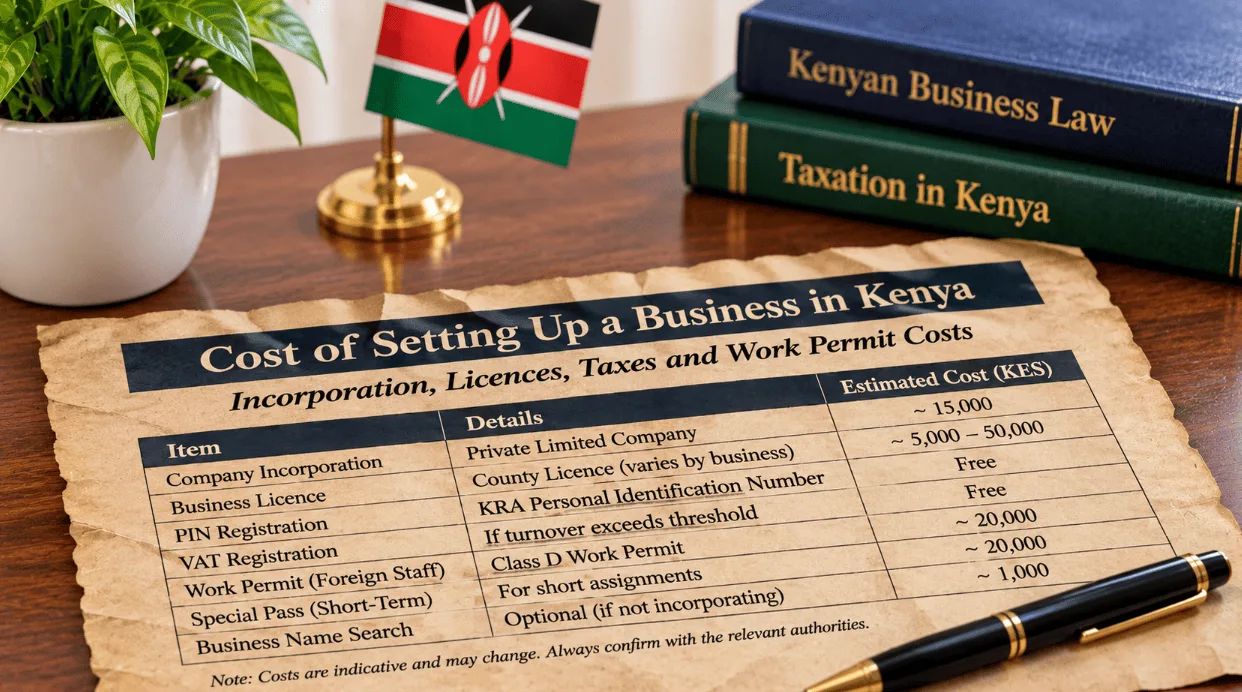
| Item | Official figure | Note |
| Incorporation, once | ||
| Name reservation | KES 150 | Thirty days, extendable |
| Private company registration | KES 10,650 | The structure most investors use |
| Branch registration, the alternative | KES 7,550 | Foreign company under Part XXXVII |
| Beneficial ownership disclosure | Nil | Filed with incorporation |
| CR12, for the bank | KES 650 | Confirms directors and shareholders |
| Before trading | ||
| KRA PIN, VAT and eTIMS | Nil | The sequencing problem, not a fee |
| County single business permit | Set by county | Scaled to business size, annual |
| Sector licence | Per regulator | Tourism, health, finance and others |
| ODPC registration | KES 4,000 to 40,000 | Per capacity, by size, two years |
| The people | ||
| Class G investor permit | KES 20,000 + 500,000 a year | USD 100,000 (about KES 12.9 million) capital evidenced |
| Class D, each foreign employee | KES 20,000 + 500,000 a year | Employer’s case with understudy plan |
| Special pass, the lawful bridge | USD 200 (about KES 26,000) a month | Six-month ceiling |
| Dependant’s pass, each | KES 10,000 | Residence only, no work rights |
| EAC citizens, Class R | Nil | DRC included, changes the maths |
| Every year after | ||
| Annual return to the Registrar | Nominal | Within 28 days of the anniversary |
| Permit renewals | KES 500,000 a year per permit | Filed ninety days early |
| County permit and sector licences | As above | Each January and on their own dates |
| ODPC renewal | KES 2,000 to 25,000 | Every two years |
The line that dominates, and the one that deletes it
Read as a whole, the table says one thing clearly. Incorporation is cheap, compliance is cheap, and immigration is the budget, since a relocating founder pays KES 520,000 for the first Class G year and the same again at each renewal, each relocating employee costs the same under Class D, and the lawful bridge while applications pend runs at USD 200 (about KES 26,000) a month. That is why the permit strategy is made with the corporate structure rather than after it, the subject our Class G article [link] walks, including whose name the capital stands in and when it lands in Kenya. The counterweight is regional, because a citizen of an East African Community state, the Democratic Republic of the Congo included, takes the free Class R permit instead, so a structure that places EAC citizens in the Kenyan roles and non-EAC founders in supervisory visits can lawfully cut the largest line in the table to nil. Few advisers model that comparison for clients, and it changes entry economics more than any fee negotiation.
Sequencing beats spending
The money above is spent well or badly depending entirely on order. The sequence that works runs the name and incorporation first, the KRA PIN route chosen before filing so the company can bank, then the permit applications with the special pass bridging the start, then the county and sector licences against the premises, with ODPC registration and the payroll file following the first hire. Run in that order the whole entry takes weeks and every fee is paid once. Run out of order it produces the stalled files this series keeps describing, the company that cannot bank for want of a PIN, the founder working unlawfully on an eTA, the opening delayed by the one licence nobody started. The table prices the entry, and the sequence protects the price.
What happens next
For an investor ready to commit, we prepare this table as a bespoke cost map for the actual venture, the real county, the real sector licences, the real headcount and its permit classes, alongside the incorporation and the immigration filings themselves, so the budget and the instruction are the same document. To have a Kenyan market entry costed, structured and executed end to end, the place to start is a conversation.
Frequently asked questions
What does it cost to set up a business in Kenya as a foreigner?
The official charges are modest, about KES 11,000 to incorporate including the name, licence and registration fees measured in thousands, and the dominant line is immigration, KES 520,000 for a founder’s first Class G year against USD 100,000 (about KES 12.9 million) of capital evidenced in Kenya. A founder-led company spends roughly KES 550,000 to 600,000 in official charges in year one.
What is the biggest cost in a Kenyan market entry?
Work permits. Each relocating founder or foreign employee costs KES 20,000 in processing and KES 500,000 for each year approved, renewed at the same rate. EAC citizens, the Congolese included, hold the free Class R permit instead, which is the single largest saving available in structuring the team.
Is there a minimum capital to start a company in Kenya?
Not for the company. Kenyan law sets no general minimum share capital. The USD 100,000 figure belongs to the founder’s Class G investor permit and the optional KenInvest certificate, so it applies to the relocating investor rather than to the incorporation itself.
How long does the whole set-up take?
Incorporation takes days once filed. A well-sequenced entry, company, PIN, bank account, permits bridged by a special pass, and licences, is trading within weeks, while the common failures, a stalled PIN or a late licence, each add a month or more, which is why the order matters as much as the money.
Which of these costs recur every year?
The permit renewals at KES 500,000 per permit per year, the county permit and sector licences on their renewal dates, the annual return within 28 days of the incorporation anniversary, and the ODPC certificate every two years. The recurring file is a diary, and the diary is the cheapest item in the whole table.
Peter Maina is a Partner of Peter Maina & Company Advocates. This article states the law as at 21 November 2026. It is general information, not legal advice. To have a Kenyan market entry costed, structured and executed end to end, reach out on e-mail peter@pmlaw.co.ke or WhatsApp +254 714 644 080.
Leave a Reply