Author: Peter Maina
-

The Landowner’s Joint Venture: Ten Terms Which Decide Whether You Get Your Units
In short, a joint venture between a landowner and a developer is the commonest way a plot in Nairobi becomes a block of apartments, and the commonest way a landowner ends up in the Environment and Land Court. The landowner contributes the land, the developer contributes the money and the building, and the landowner is…
-

The Title Is in My Brother’s Name: How Kenyans Abroad Recover Land Bought Through Family
In short, land you paid for which is registered in a relative’s name is, on the face of the register, the relative’s land. But the law recognises a trust in your favour where you supplied the money, a trust is an overriding interest which registration does not extinguish, and the Environment and Land Court declares…
-

What It Costs to Buy Land or an Apartment in Kenya in 2026: Stamp Duty, Legal Fees and Who Pays What
In short, a buyer in Kenya should budget between six and seven percent of the purchase price on top of the price itself. Stamp duty at 4 percent in the towns and 2 percent in the countryside is the largest item, the advocate’s fee is set by a published scale which starts at 2 percent…
-
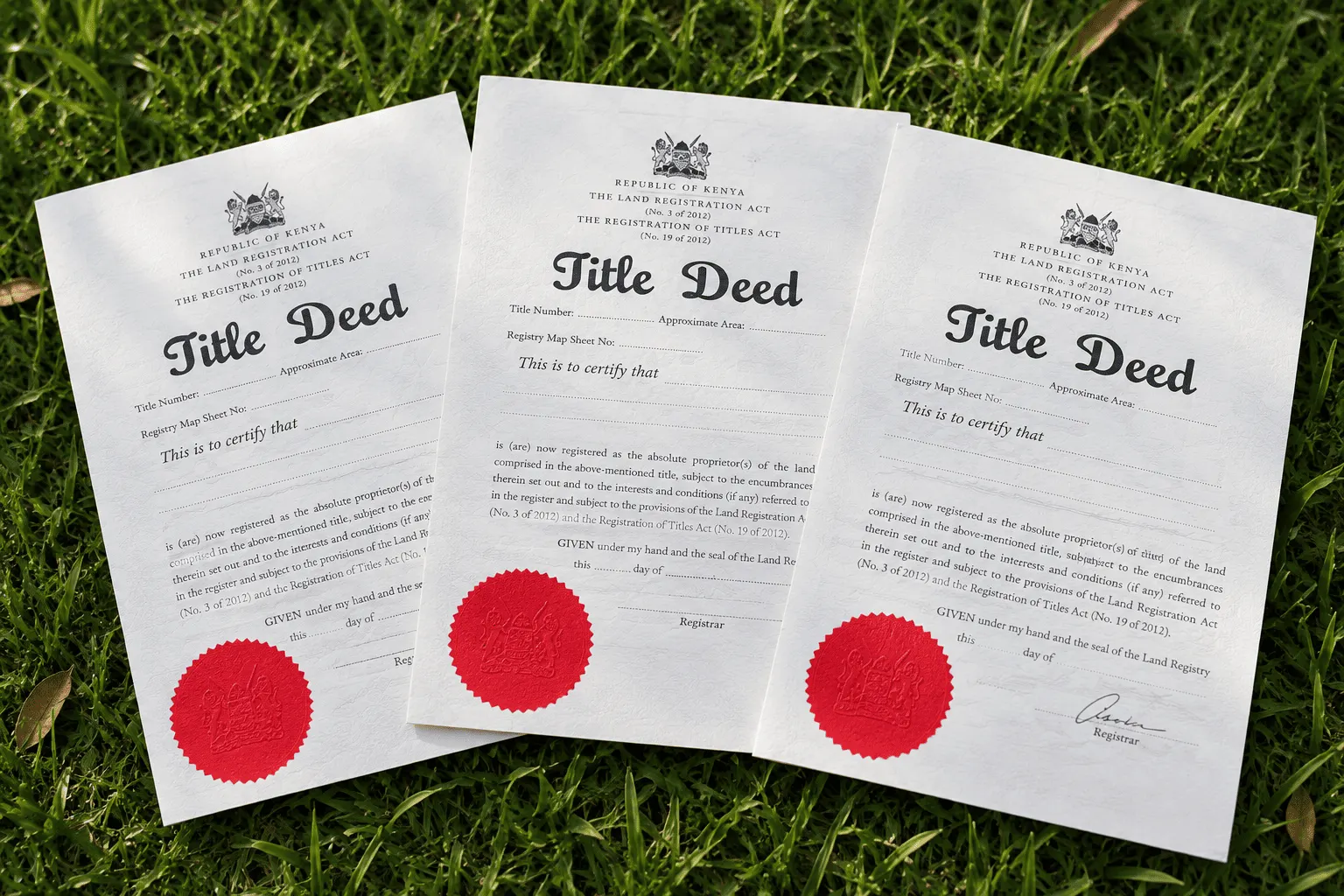
How to Verify a Title Deed in Kenya: 7 Checks to Run Before You Pay a Deposit
In short, a title deed in a seller’s hand proves almost nothing on its own. What proves ownership is the register at the land registry, the parcel file behind it, the map, the ground and the person, checked in this order and before any money changes hands. This article sets out the seven checks we…
-

How to Do a Land Search in Kenya on Ardhisasa: Step by Step, What It Costs and What the Results Mean
In short, an official land search is the one document which tells you who owns a parcel today and what is registered against it, and for Nairobi and the counties which have moved onto Ardhisasa it is applied for online, costs a few hundred shillings and comes back within a day once the owner consents.…
-

The Section 243A Contact Person: The KES 50,000 a Day Penalty Most Foreign-Owned Companies in Kenya Do Not Know About
In short, since 15 September 2023 every private company and every company limited by guarantee in Kenya which has neither a Kenya-qualified company secretary nor a director resident in Kenya must appoint a contact person, a natural person permanently resident in Kenya who keeps the company’s records of directors, shareholders and beneficial owners and produces…
-

Cost of Registering a Company in Kenya in 2026: KES 10,650 at the Registry, and Everything Else You Will Pay
In short, the Registrar of Companies charges KES 10,650 to register a private limited company in Kenya, and the registration takes three to five working days when the system behaves. The registry fee is the smallest part of the bill. A company run by Kenyan founders should budget between KES 50,000 and KES 100,000 all…
-

Governance Audits and Board Evaluations in Kenya: What the Law Requires, Who Must Do Them and Who Is Allowed to Conduct Them
In short, three separate exercises are confused with one another in Kenyan boardrooms. A board evaluation is the board assessing its own performance, and for listed companies, banks, insurers and state corporations it is required every year. A governance audit is an independent assessment of the company’s governance against a governance code, required every year…
-

Does Your Fund Need CMA Approval? Kenya’s Alternative Investment Funds Regulations Explained
In brief If you run or are raising a private equity, venture capital, private credit or property fund with Kenyan investors or a Nairobi management team, or you have been invited to invest in one, this guide tells you whether the Capital Markets Authority must approve it. For decades, private capital in Kenya operated in…
-

Is Forex Trading Legal in Kenya? The CMA Licences for Dealing Brokers, Non-Dealing Brokers and Money Managers
In brief Is forex trading legal in Kenya? Yes, and it has been regulated since 2017. Kenya has a large and fast growing retail forex market, and for years it was served almost entirely by offshore platforms, some reputable and some which vanished with deposits. The Capital Markets (Online Foreign Exchange Trading) Regulations, 2017, published…